


The question of how many top prizes left on lottery scratch cards remains unclaimed at any given moment is one that Allwyn — the operator that took over the National Lottery licence from Camelot in 2024 — is required to answer publicly, and the figures make for striking reading.
Scratch cards, or instants as the industry calls them, generate roughly £3 billion in annual sales across the United Kingdom, making them one of the most commercially significant segments of the National Lottery portfolio.
Yet despite their ubiquity — sold in every supermarket, corner shop and petrol station from Penzance to Inverness — a substantial portion of the highest-value prizes on any active game remain unscratched, unchecked or simply discarded by players who did not realise they had won.
How Many Top Prizes Left on Lottery Scratch Cards UK Are Still Out There?
Allwyn publishes prize availability data on the National Lottery website, updated periodically, which allows players to check whether the top prizes on any given scratch card game have already been claimed.

At any point in a game’s active lifespan, it is entirely normal for the majority of top-tier prizes — those at the £1 million, £500,000 and £250,000 level — to remain uncollected.
Games are typically printed in runs of tens of millions of tickets, with top prizes distributed across that entire print run at the point of manufacture.
Because cards reach retailers in batches over months, and because the public has no reliable way of knowing where in the distribution cycle a particular game sits, players routinely purchase tickets from games where every top prize has already gone — or conversely, from games where the biggest prizes are still very much in circulation.
The National Lottery’s own published data has historically shown that across all active scratch card games at any given time, between 60 and 80 per cent of the top prizes on newer games are still available in the first weeks of a launch.
For games nearing the end of their retail life — typically around 18 to 24 months after launch — that figure drops sharply, but the data consistently shows that a meaningful number of top prizes are never claimed before a game closes.
The Scale of Unclaimed Prizes
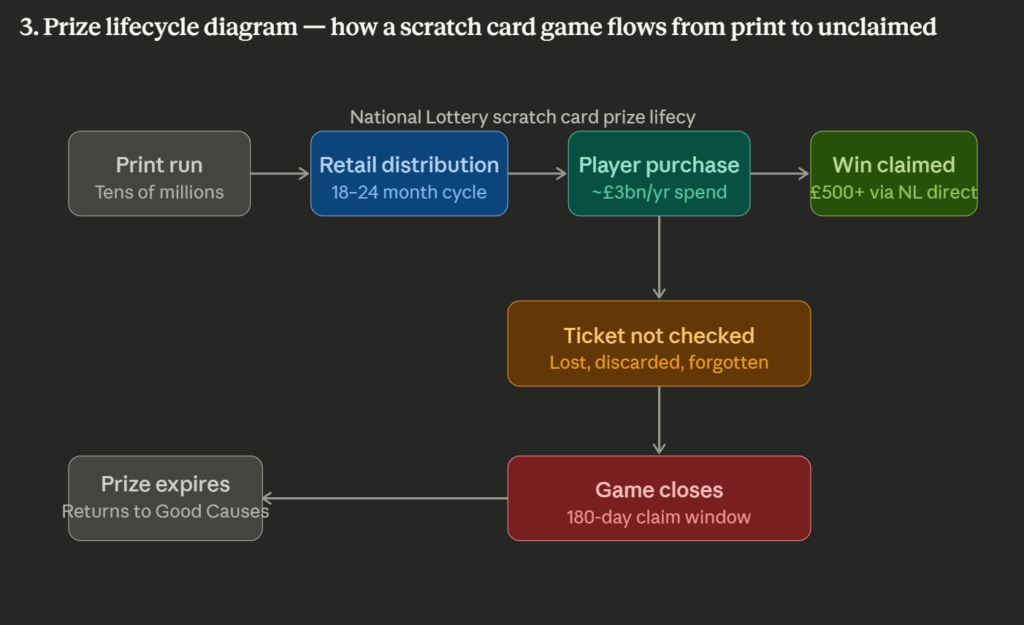
The National Lottery closes games on a rolling basis, and unclaimed prizes on closed games are subject to a 180-day deadline from the game’s closure date.
After that window expires, unclaimed prize money is directed back into the Good Causes fund, which supports arts, heritage, sport and charitable initiatives across the UK.
Over the past decade, it is estimated that hundreds of millions of pounds worth of scratch card prizes — including numerous top prizes — have gone unclaimed in this way.
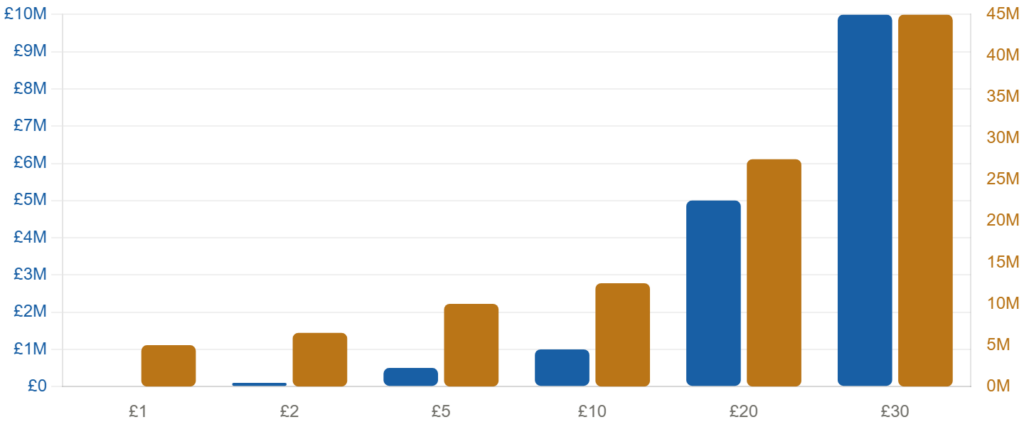
Allwyn does not publish a single consolidated figure for total unclaimed scratch card prize money across all active games simultaneously, but cross-referencing available game-by-game data suggests the figure in circulation at any one time comfortably runs into the tens of millions of pounds.
Players are encouraged to check the National Lottery website before purchasing, though in practice very few do.
Understanding the Odds: What the Numbers Actually Mean
| Game Name (Example Tier) | Ticket Price | Top Prize | Top Prizes in Game | Odds of Top Prize |
|---|---|---|---|---|
| £1 ticket game | £1 | £20,000 | 2–4 | 1 in 4–6 million |
| £2 ticket game | £2 | £100,000 | 3–5 | 1 in 5–8 million |
| £5 ticket game | £5 | £500,000 | 3–5 | 1 in 8–12 million |
| £10 ticket game | £10 | £1,000,000 | 3–5 | 1 in 10–15 million |
| £20 ticket game | £20 | £5,000,000 | 1–2 | 1 in 25–30 million |
| £30 ticket game | £30 | £10,000,000 | 1 | 1 in 40–50 million |
Figures are representative across active National Lottery scratch card tiers. Exact odds vary by game and are printed on each ticket.
The odds figures printed on every scratch card in the UK reflect the total print run, not the remaining pool of available tickets — a distinction that matters enormously to informed consumers.
When a game has sold 80 per cent of its print run and all top prizes have been claimed, the remaining 20 per cent of tickets carry no realistic chance of a major win, yet the printed odds still suggest otherwise.
Consumer advocacy groups and gambling reform campaigners have repeatedly called for more prominent real-time prize disclosure at the point of sale, arguing that the current system, while technically compliant with transparency requirements, does not adequately inform the average buyer.
Estimated Worth of Unclaimed Scratch Card Prizes in the UK
Analysts who track National Lottery data estimate that the combined value of unclaimed scratch card prizes across all currently active games in the UK sits at approximately £30 million to £50 million at any given time.
This figure encompasses prizes at all levels — from the £10 and £20 minor wins that players frequently forget to claim, through to six and seven-figure jackpots where winners have simply lost their ticket or failed to check it.
Over a full calendar year, the total value of prizes that expire unclaimed across all National Lottery products — including scratch cards, Lotto, EuroMillions and other draw-based games — has been estimated by researchers at between £100 million and £140 million annually.
The scratch card component of that figure is believed to account for the largest single share, driven by the sheer volume of lower-value wins that go unnoticed.
The £30 Ticket: Britain’s Highest-Stakes Instant Game
The introduction of the £30 scratch card — launched under Allwyn’s stewardship and representing the most expensive instant lottery product ever sold through the National Lottery — brought with it a top prize of £10 million.
With only a single top prize in the entire print run, the card offered the tantalising prospect of a life-changing sum from a single scratch, while simultaneously concentrating all the risk into a single ticket among many millions.
The game drew significant media attention at launch and sold briskly in the weeks following its release, but also attracted criticism from gambling harm charities who questioned whether a £30 price point was appropriate for a product available in high-street convenience stores without age verification beyond the standard Challenge 25 policy.
Allwyn maintained that responsible gambling safeguards were robust and that the product was aimed squarely at adults making an informed entertainment purchase.
Why Do Top Prizes Go Unclaimed?
| Reason | Estimated Share of Unclaimed Prizes |
|---|---|
| Ticket lost or thrown away | ~35% |
| Player did not realise they won | ~25% |
| Small wins not worth claiming (perceived) | ~20% |
| Player unaware of claim deadline | ~12% |
| Other / unknown | ~8% |
Estimates based on National Lottery player research and third-party consumer surveys.
The single biggest driver of unclaimed prizes, according to player research, is the straightforward loss or disposal of a winning ticket.
Scratch card players who check their card and see no obvious win on the surface frequently discard the ticket without scanning it at a retailer terminal, potentially missing secondary prizes or misreading a complex game layout.
Allwyn has sought to address this through the National Lottery app, which allows players to scan cards using their smartphone camera to receive an instant prize check — a feature that has reportedly increased the number of secondary prize claims since its wider rollout.
The Allwyn Era: What Has Changed Since the Licence Transfer?
Allwyn, the Czech-headquartered gaming company that secured the fourth National Lottery licence, formally took operational control in February 2024 after a prolonged legal challenge from Camelot, which had operated the lottery since its inception in 1994.
The company’s estimated valuation at the time of the licence award was placed at approximately £7 billion to £9 billion, reflecting the considerable commercial value of exclusive rights to operate the National Lottery for a further decade.
Under the new licence, Allwyn committed to investing significantly in digital infrastructure, retail modernisation and responsible gambling measures, with scratch card transparency forming part of that broader commitment.
The company has expanded the range of active scratch card games, meaning that at any given time there are more games — and more unclaimed top prizes — in the market than at any previous point in the lottery’s history.
What Players Can Do
Checking prize availability before buying a scratch card takes less than a minute on the National Lottery website, where each active game lists the number of top prizes remaining in real time.
Players who believe they may have a winning ticket from an expired game should contact Allwyn directly, as in exceptional circumstances the 180-day deadline can be reviewed.
All prizes of £500 or more must be claimed directly through the National Lottery rather than at a retail terminal, and players have six months from the relevant game’s closure date — not from the date of purchase — to submit a claim.
The fundamental appeal of the scratch card, the instant gratification of a physical reveal, shows no signs of fading in British consumer culture, even as digital instant-win games capture a growing share of the casual gambling market.
For those who play, knowing where the top prizes sit is, quite literally, half the battle.
